


Trade in Transformation – AI, Geopolitics, and New Brands at D-Congress
AI, Geopolitics, Transparency, and Entrepreneurship. These were some of the recurring themes at this year’s D-Congress, where thousands of decision-makers from trade, tech, politics, and entrepreneurship gathered to discuss the future of commerce. The message from the stage was clear: the pace of change is increasing, but so are the opportunities.

Photo: Svensk Handel
A Strong Economy in an Uncertain World
Sweden’s Finance Minister described a global economy in which geopolitics and trade policy increasingly influence businesses’ everyday operations. Conflicts near Europe, tensions in the Middle East, and a more turbulent global economy create uncertainty, which also affects consumption. When the government took office, inflation was around 10 percent, a quickly prioritized issue, as inflation and high interest rates directly impact household purchasing power and, consequently, trade. At the same time, Finance Minister Elisabeth Svantesson emphasized in her opening speech that Sweden remains relatively strong.
– Sweden has very strong public finances and low national debt. This gives us the ability to act if the economy weakens, said Finance Minister Elisabeth Svantesson.
To boost growth, she highlighted the need for investments in areas such as energy, infrastructure, research, and education, as well as reforms that make it easier to run a business.
The Right Rules Determine Competitiveness
After the Finance Minister’s speech, industry representatives took the stage to discuss the most important reform issues for trade. The cost of employment is a central concern, especially in brick-and-mortar retail where personnel and rent are the largest expenses. The temporary reduction of employer contributions for young employees was welcomed, but several argued that permanent changes are needed to create long-term conditions for investment and new jobs. Another recurring topic was competition from global e-commerce platforms. Several speakers pointed out that products sold via international platforms do not always meet the same safety, environmental, and tax requirements as European companies. The EU is now working on new regulations, including rules regarding duty-free small parcels, but the panel emphasized that more is needed to create a truly level playing field, a point we strongly agree with.
AI Creates Both Stress and Opportunities
AI was perhaps the most discussed topic at the conference. Many companies described how they are now training entire organizations in AI and building internal teams to use the technology in everything from customer service to assortment planning. However, several speakers also stressed that technology alone does not solve everything. True transformation is about how companies change their working methods, decision-making, and organizational structures. AI can enable deeper data analysis, automation of certain business processes, and more personalized customer experiences. Yet consumer behavior does not change overnight. Even in a more AI-driven world, experiences, inspiration, and human interactions will continue to play a central role in commerce.
Transparency Becomes the Next Competitive Factor
Another clear trend is increasing demands for transparency. With AI and digital metadata, consumers will soon have much greater insight into how companies operate, from supply chains to climate impact. Speakers also highlighted the potential to create new forms of certifications, where companies are evaluated based on ethical and sustainability criteria. In such a world, stores can become more than sales points, they can become places where companies showcase the stories behind their products and build trust.
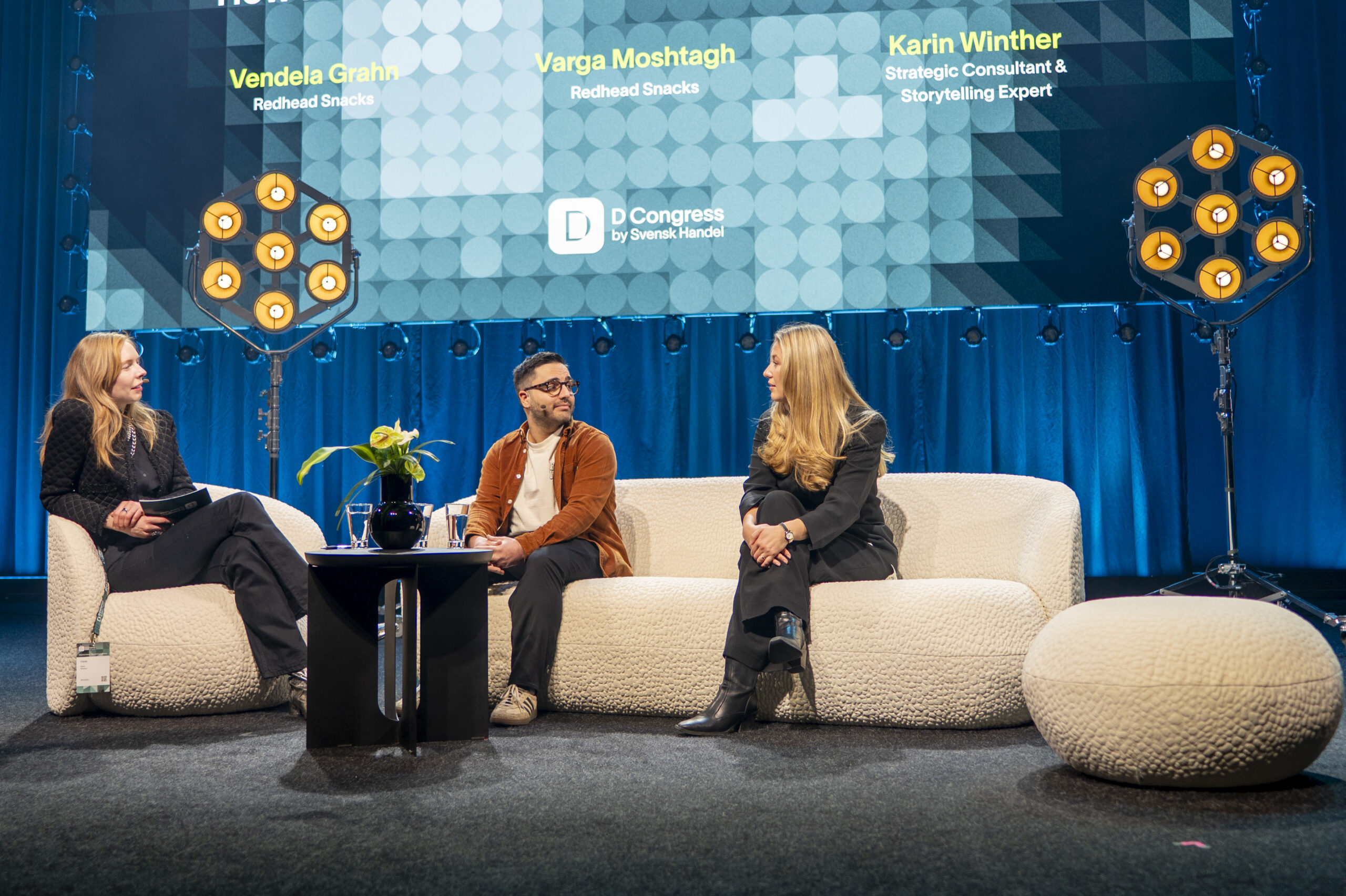
Photo: Svensk Handel
Culture, Community, and New Brands
While AI transforms trade, several speakers emphasized the importance of culture and community. In a digital world where much can be automated, physical meetings, local contexts, and authentic relationships become increasingly important. This is particularly true in fashion and street culture, where trends often emerge from local creative environments. The conference concluded with a discussion on entrepreneurship and brand building with the team behind the snack brand Redhead Snacks. Founder Mauri joined briefly via FaceTime to share the journey of building a new brand in a category long dominated by a few large players. Today, the company holds around 3–4 percent of the market and aims to continue growing. But entrepreneurship also entails constant uncertainty.
– In my mind, I always think that everything could go wrong soon. So we just have to keep working even harder, says Mauri Hermundsson, founder of Redhead Snacks.
A sentiment that many can surely relate to.
An Industry in Rapid Change
If anything became clear at D-Congress, it is that trade is currently undergoing multiple transformations simultaneously:
Geopolitics affects the economy.
AI changes work methods and customer relations.
Meanwhile, new entrepreneurs and creative brands continue to challenge established markets.
And in the middle of it all is the consumer, whose expectations for service, transparency, and experiences continue to rise. For trade, the future is not only about adapting to change, it is about actively shaping it.
Together with all members of Trade Partners and Stockholm Fashion District, we see the importance of remaining highly active!
By Helena Waker, CEO of Trade Partners and Stockholm Fashion District.
